
The Space Where Perfection, Beauty, and Reality Come Together
by Robert Hayden III
During the fall of 2004, Hadi Tabatabai wrote an appreciation of Agnes Martin, describing his inspirational visit with the artist, aged 92 years, at her Taos, New Mexico studio.1 The meeting was the result of a plucky act. Having never met Martin, Tabatabai sent her one of his small paintings as a gift. To submit a work to the scrutiny of one of the most esteemed American artists of the second half of the twentieth century was a bold and courageous act, especially for an artist who, at the time, had only been exhibiting for three years. To his surprise, shortly after sending the painting, he received a telephone call from Martin thanking him for the gift and inviting him to visit her in Taos.
Within a year, Tabatabai took her up on the offer. During the visit, while discussing Martin’s aesthetic theories, he asked Martin if she thought perfection, beauty, and reality were one and the same. Upon reflection, Martin countered that they are different, but there is a place where all three come together.2 That Tabatabai introduced these three qualities as the topic of conversation is not surprising. His paintings are perfect in their precise execution, beautiful in their ethereal simplicity, and, despite being wholly nonrepresentational, they are grounded in reality.

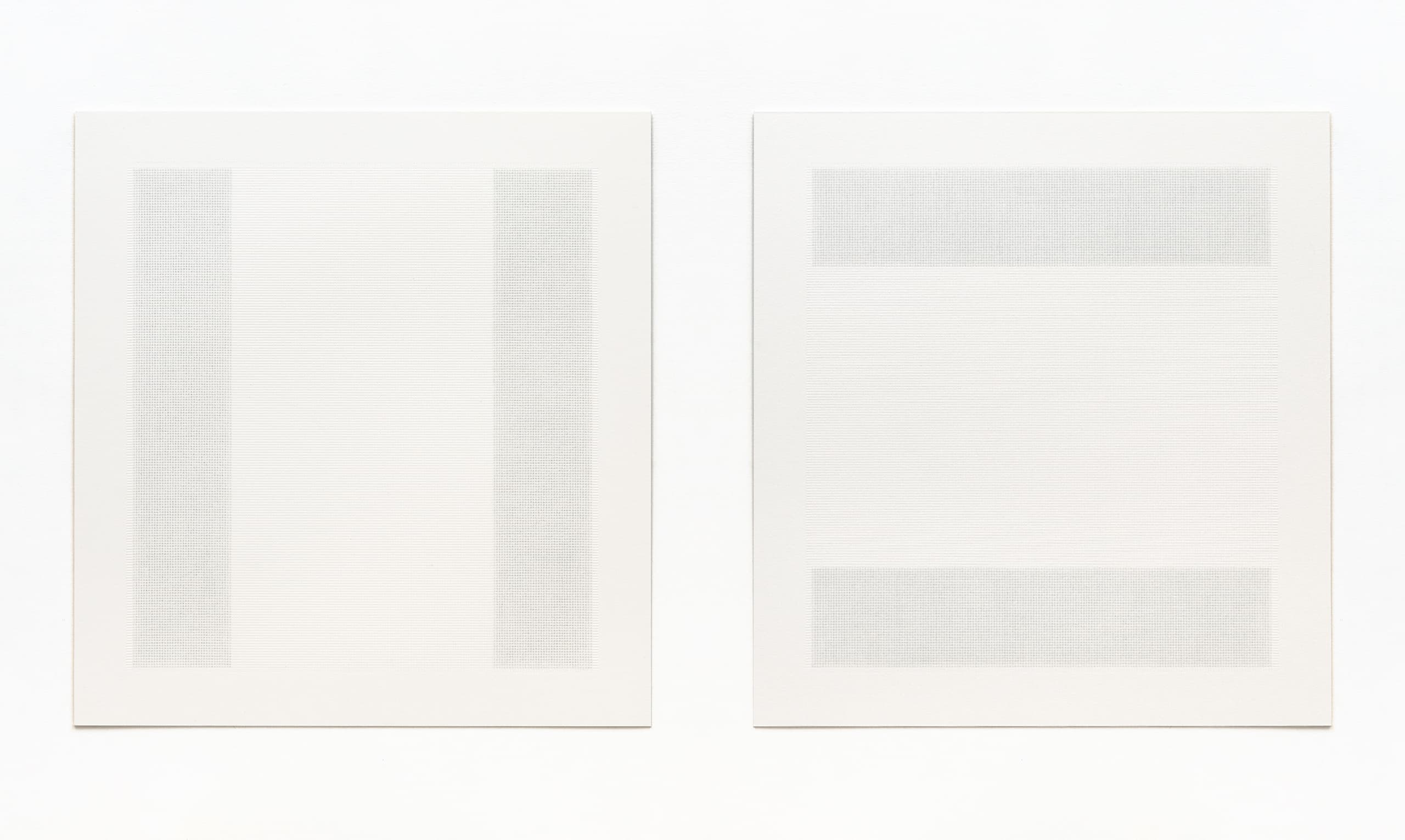
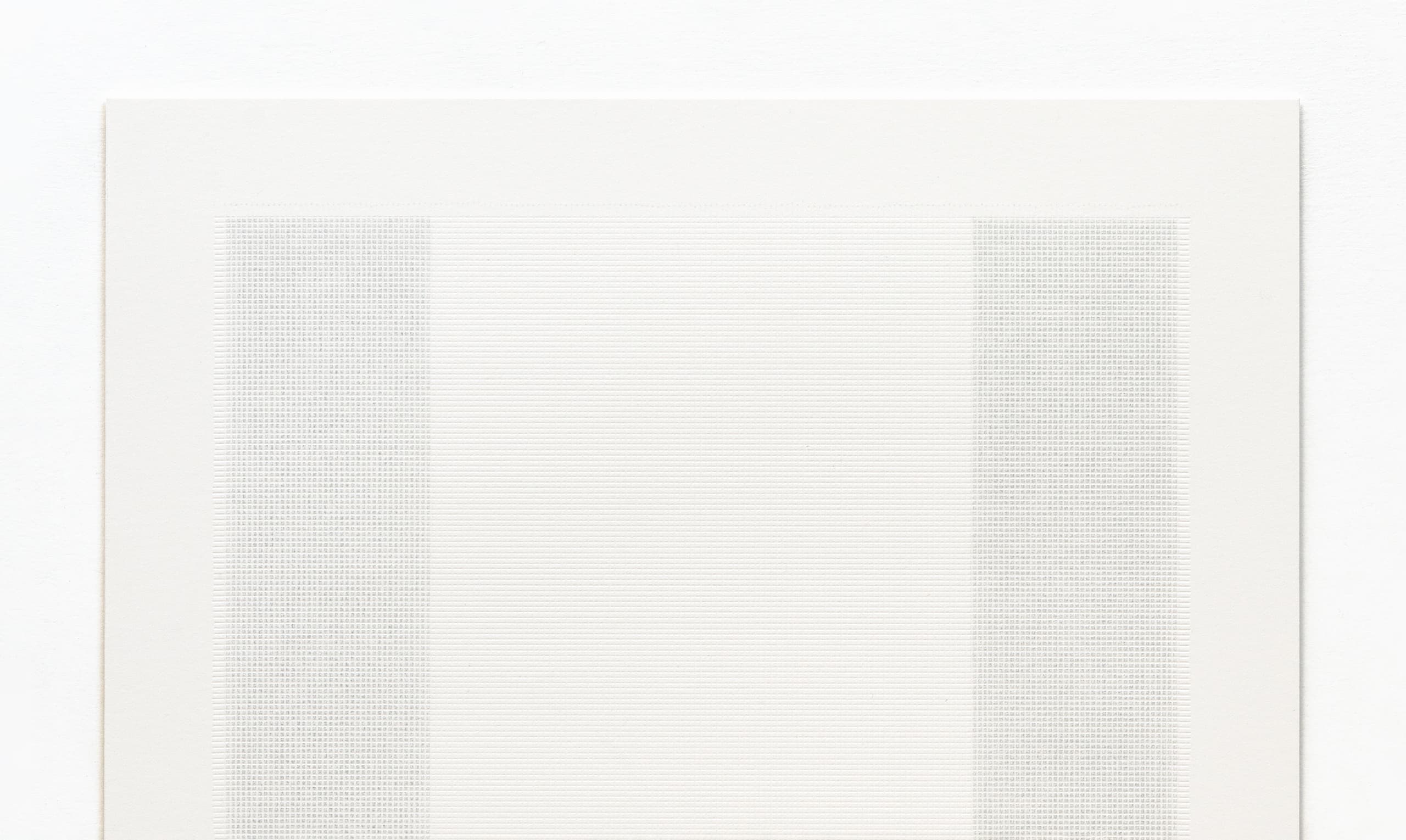
Hadi Tabatabai. WEAVE 2013-1 and WEAVE 2013-2 (2013) | Coloring pencil on paper, 15 x 14 in (38 x 35.6 cm), each piece
Sadly, Agnes Martin passed away four months after his visit. With the addition of a postscript to his original essay, he submitted his eloquent appreciation for publication as an in- memoriam in which he eulogized his idol.3 Rarely does the opportunity arise to meet one’s idol. When the opportunity does arise, the encounter may just as likely conclude with disappointment rather than a deep sense of satisfaction. For Tabatabai, the visit with Agnes Martin was a watershed moment, an acknowledgment by the master of the younger artist’s skill.
In his elegy for Martin, Tabatabai described his active participation in the making of art as a method by which he explores his humanity. Of course, all art expresses the experience of its creator. However, Tabatabai found that through the process of mark-making he could focus on his own lived experience and stop “reacting to what was outside.”4 This implies a central tenet of his art, the exploration of the inner self. Agnes Martin’s response to the small painting that he sent her is not surprising. Both artists incorporate the grid as a compositional device to express simplicity, purity, and what Martin referred to as innocence—purity of spirit and expression.5
Tabatabai’s mark making can be understood as a form of repetitive task meditation, much like raking a path, sweeping a floor, or weaving a textile. His Weave Drawings and Thread Paintings are linked to the repetitive task of weaving by title and, in the case of the thread paintings, also by the material. This fact becomes pertinent when you consider that woven textiles are a significant, yet under-recognized chapter in the story of twentieth-century nonobjective art. They relate to Tabatabai’s paintings in concept and construction.
The longest operating and most successful of the Bauhaus workshops, the Weaving Workshop, introduced the formalist theories of Bauhaus instructors Wassily Kandinsky, Paul Klee, and László Moholy-Nagy to artist-weavers like Margarete Reichardt, Gunta Stölzl, Margarete Bittkow-Köhler, and Anni Albers.6 The elimination of the object from art was central to Kandinsky’s revolutionary practice and greatly influenced the woven designs produced by the Bauhaus Weaving Workshop.7 In their handwoven textile designs, these artists used grid based nonobjective patterns that manifest a spatial flatness, as do Tabatabai’s paintings at first glance.
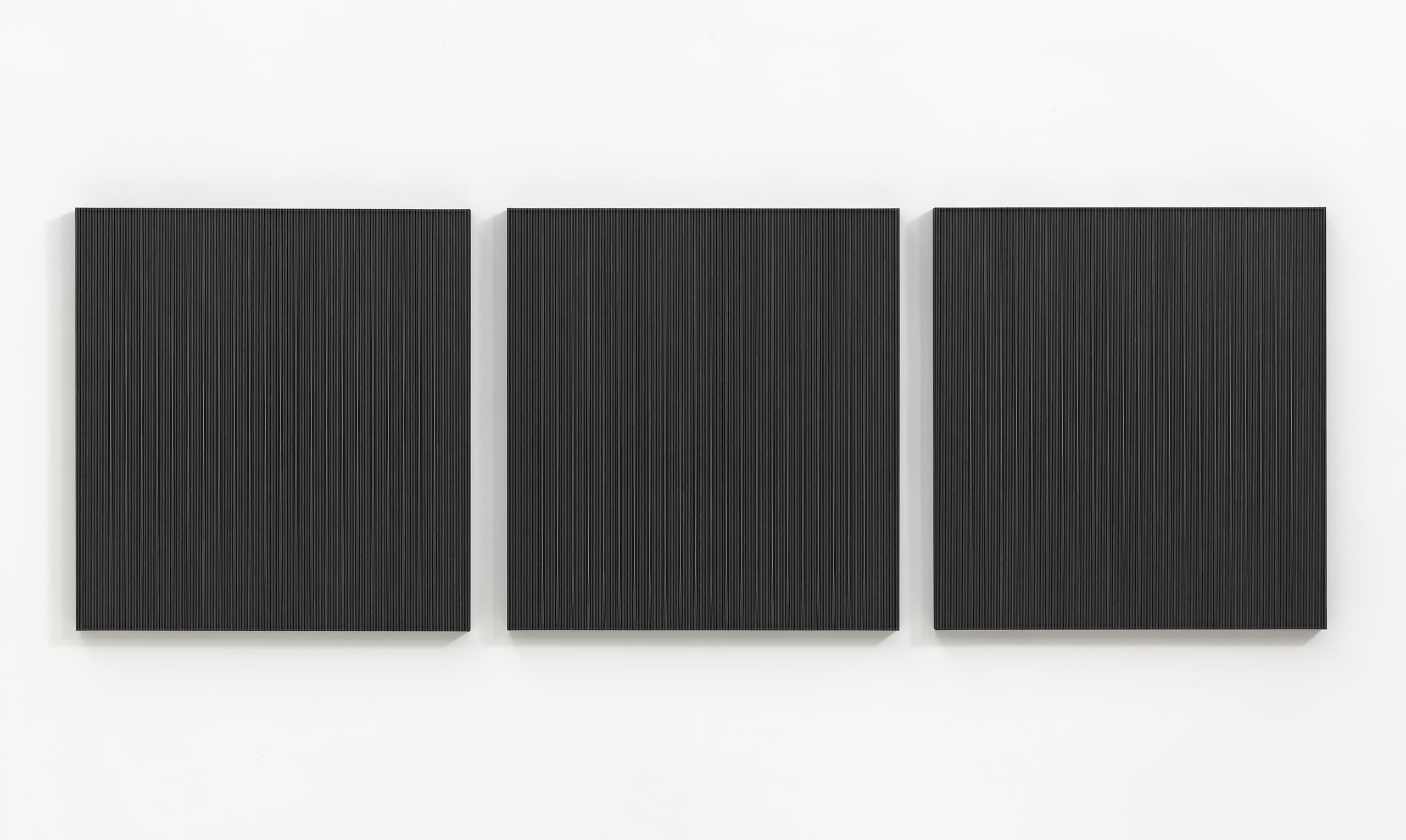
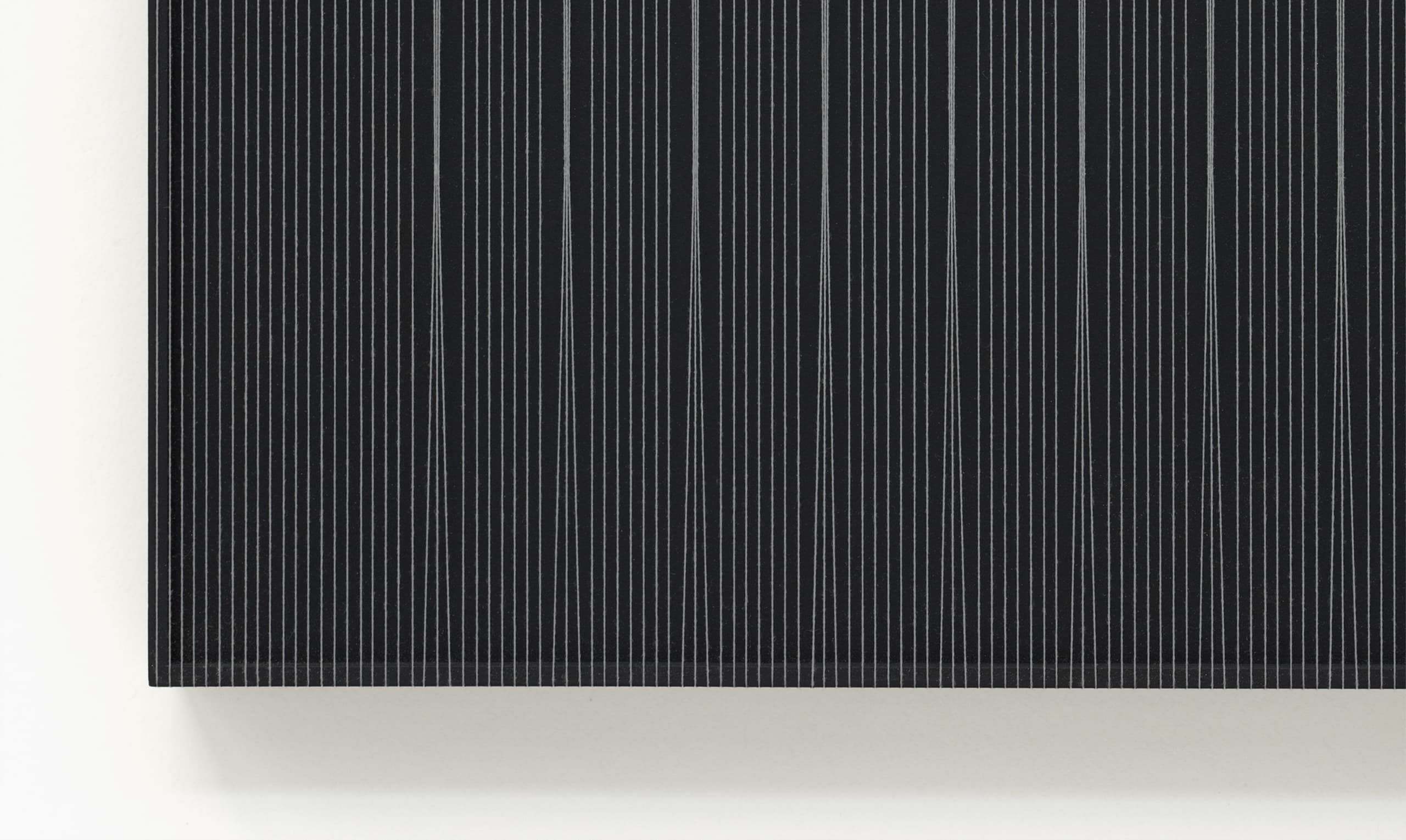
Hadi Tabatabai. THREAD PAINTING 2011-2 (2011) | Wood, thread and acrylic paint on plywood, 17 × 16 × 1 in (43.2 x 40.7 x 2.5 cm), each panel
While the history of modernism is concerned with flattening a three-dimensional world, Tabatabai’s paintings represent both a debt to and a break from this tradition. The flatness of his paintings is broken by subtle volumetric-spatial construction. Rather than creating an illusion by means of traditional one-point perspective, light and shadow, or color juxtaposition, he creates real space. By layering paint on both sides of an acrylic panel or stringing taut thread over an inset panel, he introduces a subtle, almost imperceptible sense of depth. The supports of his paintings are relatively thin, usually less than one inch, so the actual space is slight. But the depth is profound. For example, Thread Painting 2011-2 is a monochromatic black triptych with evenly spaced threads wrapped over the surface of each panel. The light reflecting threads create the effect of a scrim. However, this effect is interrupted. About every one-half inch, four threads pinch near the center of each panel, simultaneously creating a line and a fissure. Near the edges, the threads separate and the lines dissolve. The surface and the exposed space below are two coexisting planes.
Tabatabai’s paintings require prolonged, careful observation to detect the subtle perceptual activity created by the space. He uses an achromatic palette and a relatively small format—the paintings generally measure not more than an arm’s length. The subtlety of the paintings places demands on the viewer’s perceptual skill like those required by Ad Reinhardt’s monochromatic paintings, especially his black paintings of the early 1960s, or Robert Irwin’s dot and late line paintings from the same period.
As is the case with Reinhardt and Irwin, photographic reproductions do not convey this subtlety. At a time when art is often reduced to nothing more than an image on a screen, Tabatabai’s paintings negate the ability of the photograph to appropriate the object as an image. We are directed back to an experiential engagement with art as object.
There is a history of minimalist nonobjective painting eluding accurate photographic reproduction. For example, to emphasize the necessity of the viewer’s engagement with the actual work of art, in the mid-1960s, Irwin prohibited the reproduction of his artwork in exhibition catalogs and other publications.8 In a “Statement on Reproductions” published in Artforum in June 1965, he wrote, “Non-objective art as I see it removed the referential (idea- identity) from painting – demanding personal sensual involvement as the only accurate human communication.”9 Irwin’s bolded text is apropos of the chief concern of Tabatabai, to tell the story of the human experience through the artist’s experience of creative mark-making, the precise and laborious process of laying down threads or painting fine grid patterns.
In his essay on Agnes Martin, Tabatabai explained his artistic intentions when he wrote, “Only one story was important: it was the story of the human experience, the one that used a different thread every day, but wove the same fabric.”10 The act of art-making is highly personal to him, yet his paintings address the universality of the human experience. During his Taos studio visit, Agnes Martin reflected on perfection, beauty, and reality and proposed that there is a place where they all come together. With a focus on the process of art-making, he found a method to engage his mind and eliminate externalities by perfectly constructing representations of truth, beauty, and reality. Indeed, the place where the three qualities come together is in the space of a Hadi Tabatabai painting.
— Robert Hayden III
- Hadi Tabatabai, “In Memory of Agnes Martin: Hadi Tabatabai”, Works & Conversations (Berkeley, Conversations.org, 2004)
- Ibid.
- Ibid.
- Ibid.
- Nancy Princenthal, and Agnes Martin, Agnes Martin: Her Life and Art (New York, Thames & Hudson, 2015) p. 89. Commenting on her use of the grid in what she considered her “first really abstract painting”—The Tree, 1964 (collection Museum of Modern Art)—Martin said, “When I first made a grid I happened to be thinking of the innocence of trees and then this grid came into my mind and I thought it represented innocence.”
- Sigrid Wortmann Weltge, Women’s Work: Textile Art from the Bauhaus (San Francisco, Chronicle Books, 1993) p. 10.
- Ibid, p. 41
- For example, the catalogue for Robert Irwin Kenneth Price, curated by Maurice Tuchman at the Los Angeles County Museum of Art in 1966 states, “At the request of Robert Irwin no photographs of his work are included in the catalog.” The exhibition catalog Robert Irwin: All the Rules Will Change (Washington, D.C., Hirshhorn Museum and Sculpture Garden, Smithsonian Institution, 2016) p. 78, includes photographs of dot and late line paintings with the following artist’s note, “The optics of the following four series of works require firsthand experience, going beyond the limitations of photography and effectively breaking the time-honored frame of painting.”
- Robert Irwin, Notes Toward A Conditional Art. Edited by Matthew Simms (Los Angeles, Getty Publications, 2011) p. 21-22.
- Ibid. Tabatabai.
Robert Hayden III is an art writer and historian with a research focus on modern and postmodern art, particularly in the Americas and Europe. Currently affiliated with the University of California, Irvine, his academic interests include the study of geometric abstraction, the monochrome in modern art, and post-World War II visual art in Los Angeles. Hayden is also involved in work related to the cataloging and interpretation of mid-20th century artists, such as John McLaughlin.
Hayden served as a board member at the Laguna Art Museum from 2009-2018.