
Complexity Resolved
by Peter Lodermeyer
Simplicity is complexity resolved.1
— Constantin Brancusi
I.
Going completely against my habit, I would like to write here from a rather personal perspective. The circumstances call for this. I am sitting at the kitchen table in my apartment in Bonn (my predilection for writing texts at the kitchen table harks back to university days, long past), switching back and forth from gazing out the window and then at the photos in the PDF that Hadi Tabatabai sent to me several weeks ago. He wanted to show me what the catalogue he is planning is to look like. I like thinking about works of art that are in San Francisco right now, and thus (if I may trust the website www.luftlinie.org) roughly 5600 miles away from me. But I also have to admit I bemoan the fact that I do not have any of these works here before me in the original. How much easier the writing would be then. Though who knows, maybe it would be all the more difficult.

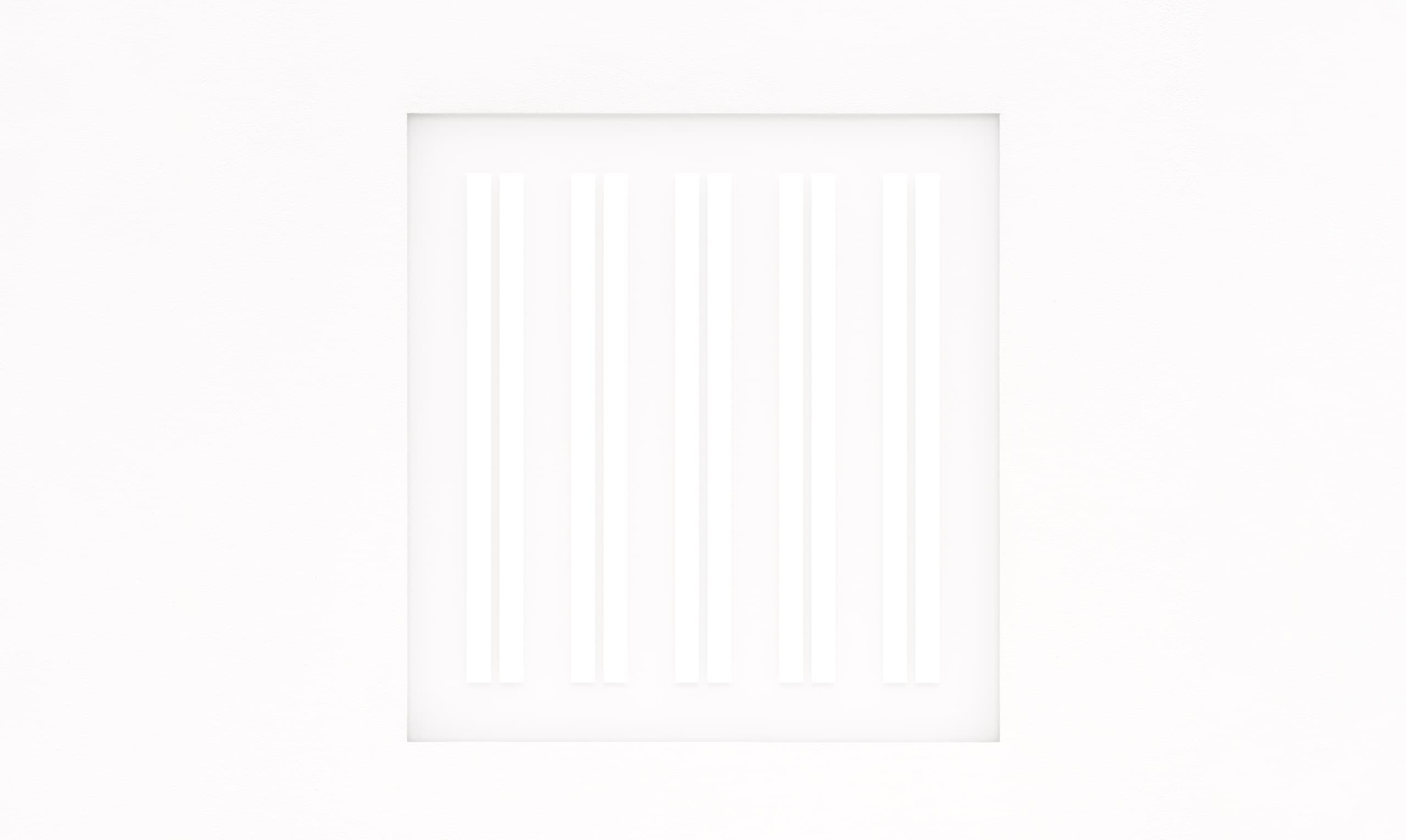
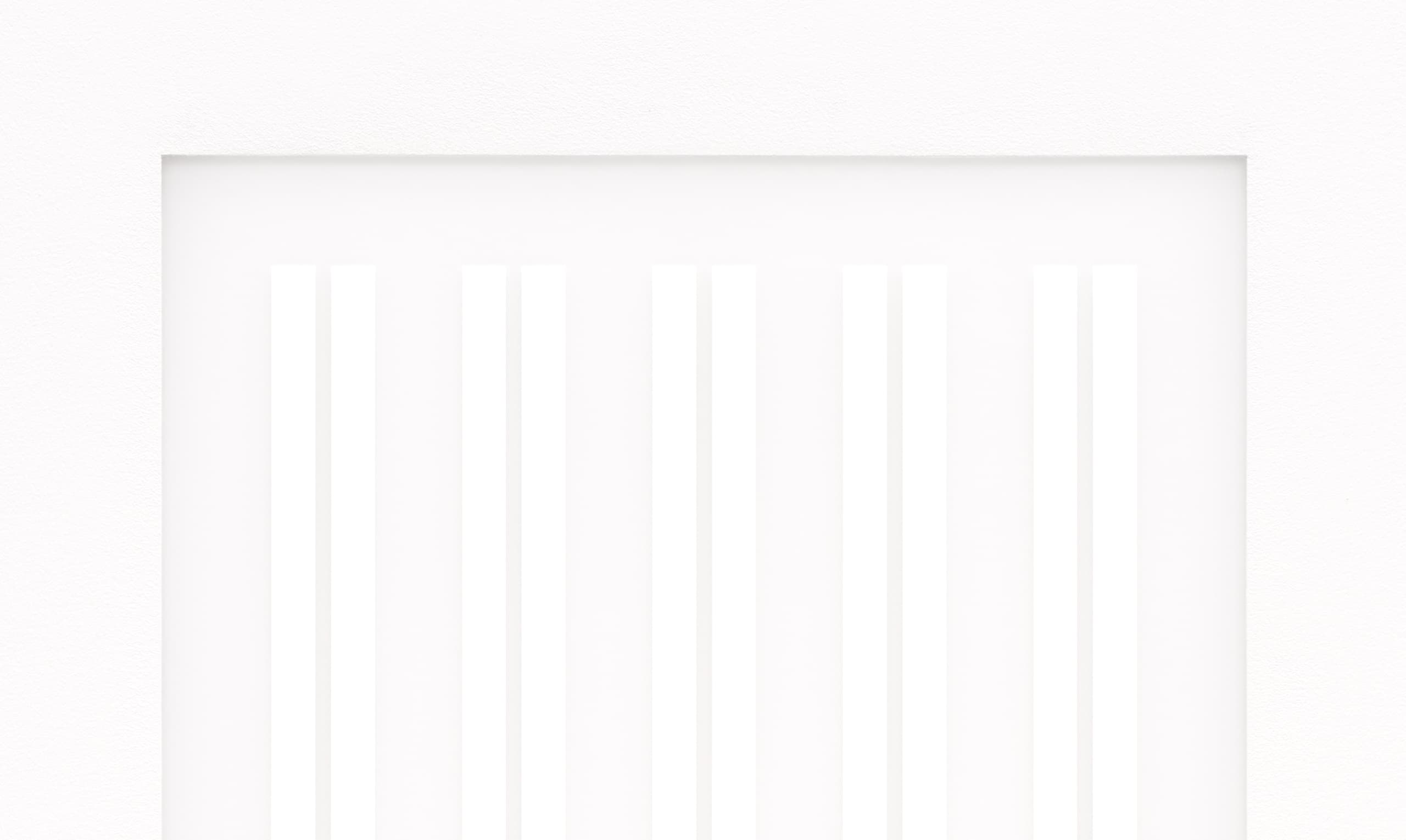
Hadi Tabatabai. WALL PIECE 2016-4 (2016) | Acrylic paint on cast acrylic panel, 17 x 16 x 0.2 in (43.2 x 40.6 x 0.5 cm)
With respect to any good work of art, it goes without saying that it cannot be adequately represented in photographic reproductions because inevitably, decisive information gets lost in the process. But in the case of Hadi Tabatabai, this holds particularly true. A person who has only ever seen photographs of his works does not know his work at all. However, anyone who has stood face-to face with some of his pieces, looked at them, or more aptly: experienced them, might perhaps be in a position to summon enough imagination from gazing at the image reproductions to recall something of the surprise that comes about in the act. Someone, though, who only has the photo images might think: oh, right, geometry, grids, construction, reduction and all those other bone-dry nouns that rattle around in our heads. A few years ago, I began a short exhibition text about Hadi Tabatabai by saying: “I would prefer not to use the word minimalist.” Of course, I liked the allusion to Melville’s “Bartleby, the Scrivener”2, but above all, the statement was an incantation against the habits of my own trade. As an art historian, one tends to sort art works immediately into categories of style. The notion or even superstition behind this consists in thinking that by doing so, something of its “essence”, its “actual meaning” will have been comprehended.
Minimalism is only one of these magic words that might occur to us when confronted with the art of Hadi Tabatabai. Constructivism would be another one. Or Concrete Art. And the word grid also shoves its way to the forefront. How tempting it would be to quote a couple of intelligent statements from Rosalind Krauss’s brilliant essay “Grids” from 1979: “There are two ways in which the grid functions to declare the modernity …”3 Stop! Honestly, how many pictures have already been painted, how many drawings have been made in which the horizontal and vertical grid has been trotted through all of its forms of declension? It may be an exaggeration, but it seems to me there are just as many of these as there are the countless “Madonna and Childs” that have been painted on panels and canvases over the course of the centuries of the history of European painting—a total and disconcerting redundancy. Is it really necessary to draw a grid yet again in order to demonstrate on the one hand how the picture field is structured and confirmed by this, but on the other hand, that it virtually expands beyond these borders into a potentially endless continuum?
Yes, in his art Hadi Tabatabai works with horizontal and vertical lines, others do not occur. Yes, of course these are constructions. How else are they supposed to come about, if not in a constructive act? And without precisely measuring the intervals, it cannot be done. So they are geometric – and granted, they are also concrete. What could be more concrete than this clarity of construction, this simplicity of the black and the white, without shades, without compromises? (Incidentally, years ago in conversation Hadi Tabatabai related that he avoided colors in his work because these always conjured up associations. With blue you think of the sky, with green of the trees and grass, with red you think of blood… That made sense to me. But today I think that even with black and white you cannot escape the associations. With black I think of night, and white I think of day. The night/day alteration as the mother of all polarities, the absolute restraining of light as opposed to its absolute outpouring, the circadian rhythm as the timekeeper of life, minus – plus, switch off – switch on, these polarities without which we cannot imagine anything in the world – and also not calculate it, just as the binary switch statuses of 0 and 1 prove in the digital world.)
II.
What is utterly remarkable about Tabatabai’s art is the fact that although he exercises a well-known formal vocabulary that has been often used and purportedly exhausted from A to Z, nevertheless he employs it in a way heretofore unseen. He turns his works into precision instruments for sight, perception and consciousness. His works demand absolute attentiveness, requiring a concentrated view from close up, a close reading, one that discovers unexpected complexities in the supposed simplicity of the formal construction. What about the nylon threads that show up and disappear? Where exactly are they located, what precisely causes them to change color? This is not demonstrated in a didactic manner, but proffered for our joy of discovery. And this joy of discovery is not only for aesthetic reasons, but for philosophic ones as well. Hadi Tabatabai emphasizes his conviction that we are able to reach reality and be in a position to understand it. He is no epistemological Constructivist who regards reality as a mere effect of the brain’s achievements in constructing it.


Hadi Tabatabai. WALL PIECE 2014-1 (2014) | Acrylic paint on cast acrylic and rare earth magnets, 50 x 7 x 0.3 in (127 x 17.8 x 0.6 cm)
A further aspect that makes Tabatabai’s works so unique is their generous nature, which is the opposite of monumentality. Although most of the works are small to medium in format, they often convey a profusion of information, a lavish abundance of elements: the hundreds and hundreds of precisely strung threads in his Thread Pieces, where two dozen would have certainly sufficed if this were only about demonstrating an effect. Or the 8 times 49, i.e. 392, rectangular platelets held in place with magnets in Wall Piece 2014-1 (which only seem like squares to the superficial gaze with its visual prejudices). This plethora adds a Dionysian element of excess, overexertion and overabundance to Tabatabai’s Apollonian aesthetics of measure and clarity.
But the most surprising thing about Tabatabai’s works, something you can only really grasp if you actually see them, is the fact that they make a theme of space. The grids he uses are not the grids referred to by Rosalind Krauss. Krauss thinks of her “grids” in Greenberg’s sense of flatness: the flatness of the modernist picture as the media-specific trademark for painting as opposed to sculpture, which addresses of three-dimensional space. But Hadi Tabatabai’s works are not pictures, not paintings, even if they appear to be at first glance. On the contrary, this is merely mimicry for the purpose of heightening the viewer’s attentiveness. Neither are these works sculptures, though they are nevertheless objects that thematize space – not illusionistic space, of course, but real space. Their grids are not structurings of the surface, rather they open up the space. With respect to the real three-dimensionality of space namely, it makes no difference whether its depth is only a few millimeters (such as is the case with the distance from the threads to the background surface in the Thread Pieces) or whether it is measured in light years. It is the real space that plays an unexpectedly major role in Tabatabai’s works. This applies even for the intarsia inlays of his Acrylic Pieces, which display a smooth surface but one where layers of transparent acrylic cause the gaze to fall into the interior of the object, thus creating an interior space. In the case of the most recent works Wall Piece 2016-1 and Wall Piece 2016-4 Tabatabai radicalizes this approach in a sheerly breathtaking manner in as much as he makes the object itself an inlay, inserting it in a way that makes it flush with the wall. In so doing, the nature of the work as a painting is negated and even carried to the point of the absurd, and the space in the interior of the wall is activated. As viewers our gazes penetrate into the wall functioning as a container of space. Thus, a wholly new and unexpected yet completely logical approach comes about in the artist’s work.
I do not speak Farsi and therefore cannot know precisely what all the word daruni entails that Hadi Tabatabai is fond of using for characterizing his notion of space. But I suspect, purely intuitively, that it must be related somehow to the term “Weltinnenraum (world’s inner space)”4 as used by the German poet Rainer Maria Rilke: an area in which the real space of the world touches the spatial depths of consciousness and partially overlaps.
III. Epilogue
I am thumbing through the book “The User Illusion”5 by Danish author Tor Nørretranders. The only reason for this is that Hadi Tabatabai has told me that he is studying this book at the moment. The chapter on complexity has a magnetic attraction for me because over and over again I have been pondering why I do not feel that Tabatabai’s works are formally reduced or simple, but highly complex. The fact that I consider Constantin Brancusi’s statement “Simplicity is complexity resolved”1 (similar such statements are known to have been made by Donald Judd) to be an apt description of works by Tabatabai likely needs no further comment in light of what has been said up to now. I am excited that Nørretranders takes the concept of depth as a theme. I interpret the final sentences in the chapter “The Depth of Complexity” as descriptions of what happens when gazing at Tabatabai’s works. The risk of misunderstanding the author because I have taken his sentences completely out of their context and interpret them as a commentary on experiencing Tabatabai’s artworks is something I calmly accept: “Depth shows that something has interacted with the world. It has changed, but it is still itself; out of balance but not out of itself. It has known surprises in its time. But it is still here. It has marked the world, and the world has marked it. It has grown deep.”6 Whether we choose to apply these sentences to the viewer or the thing viewed or even to the decisive relation between both is of no relevance with respect to the concept of “Weltinnenraum”, the world’s inner space.
— Peter Lodermeyer
- Quoted in Constantin Brancusi by F. Bach. M. Rowell, A Temkin (Philadelphia Museum of Art, 1995), p. 23.
- Herman Melville, “Bartleby, the Scrivener: A Story of Wall Street” (New York, Putnam’s Magazine, 1853)
- Rosalind E. Krauss, “Grids”, The Originality of the Avant-Garde and Other Modernist Myths (Cambridge, The MIT Press, 1986) p. 9-22
- Beda Allemann, Zeit und Figur beim späten Rilke: Ein Beitrag zur Poetik des modernen Gedichtes (Germany, Pfullingen: Verlag Günther Neske, 1961).
- Tor Norretranders, The User Illusion: Cutting Consciousness Down to Size (London, Penguin Books, 1999)
- Ibid, p.88
Peter Lodermeyer was born in Ottweiler (Saar), Germany in 1962. He attended Rheinische Friedrich-Wilhelms-Universitaet in Bonn, Germany receiving multiple degrees in 1983 for Art History, Philosophy, and German Literature. In 1992 he earned a Masters of Arts in Art History and in 1997 a PhD degree in Art History. Since 1999 Peter has been working as an art historian and author for books, artist catalogues, articles in national and international professional magazines, art magazines, and broadcast. In addition he has been active with art exhibitions, organization of and participation in international symposiums, special tours at museums and art fairs, lectures, as well as other speaking engagements.