
At the Edge of Perception
by Maria Porges
I. Limen
The problem with language is that it is made out of words. I can tell you about a person, a place; a smell, a sound, or a quality of light, but my description is just an abstraction of the things I am talking about. Although a word can evoke a feeling (and often does), there is no guarantee that the contents of a powerful phrase: the associations that lie beneath its skin, will be the same for you that they are for me. Unable to enter each other’s minds, we can never be sure that our experience of things truly coincides—that the colour of the sky or the taste of rice is the same for us both. All we really know (or think we know) is that what we call rice isn’t what we call blue.1
Working within a strictly limited set of variables, Hadi Tabatabai has spent the past two decades exploring a visual realm that can only be imperfectly described in words or revealed in reproductions. Rigorously investigating the transitional spaces between mark and matrix: working in the delicate, almost invisible margin between planes of thread and the materials to which he affixes them, Tabatabai draws his viewer’s eyes to the limen, or edge, of perception. To him, this is the place where the real experience of his work exists.
For the most part, Tabatabai’s work defies categorization, in that it frequently combines sculpture, drawing and painting. For the purposes of this essay, however, his pieces can be said to fall into one of four groups: objects that are essentially in the traditional painting format and hang on the wall; works that are made or installed directly into the wall’s surface; works consisting of multiple modular elements that attach to that surface, incorporating it as part of the work; and installation pieces. Transitional Spaces, Tabatabai’s contribution to this exhibition, represents the last of these. In it, the artist’s evocation of liminal space becomes fully three-dimensional, creating an experience that, even more than his wall-bound work, requires the viewer to experience its ethereal planes of painted thread from multiple viewpoints, to visually enter its world.

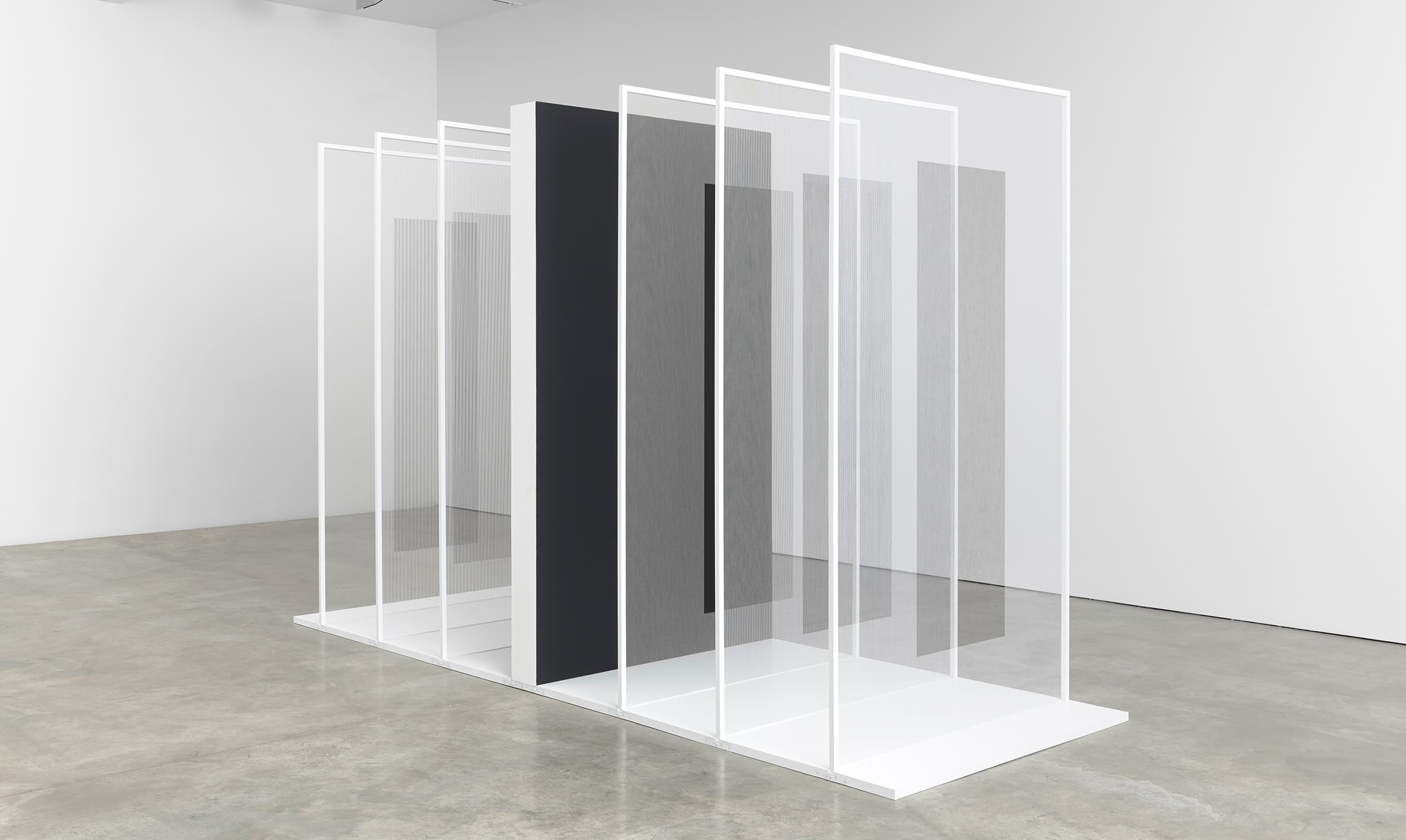
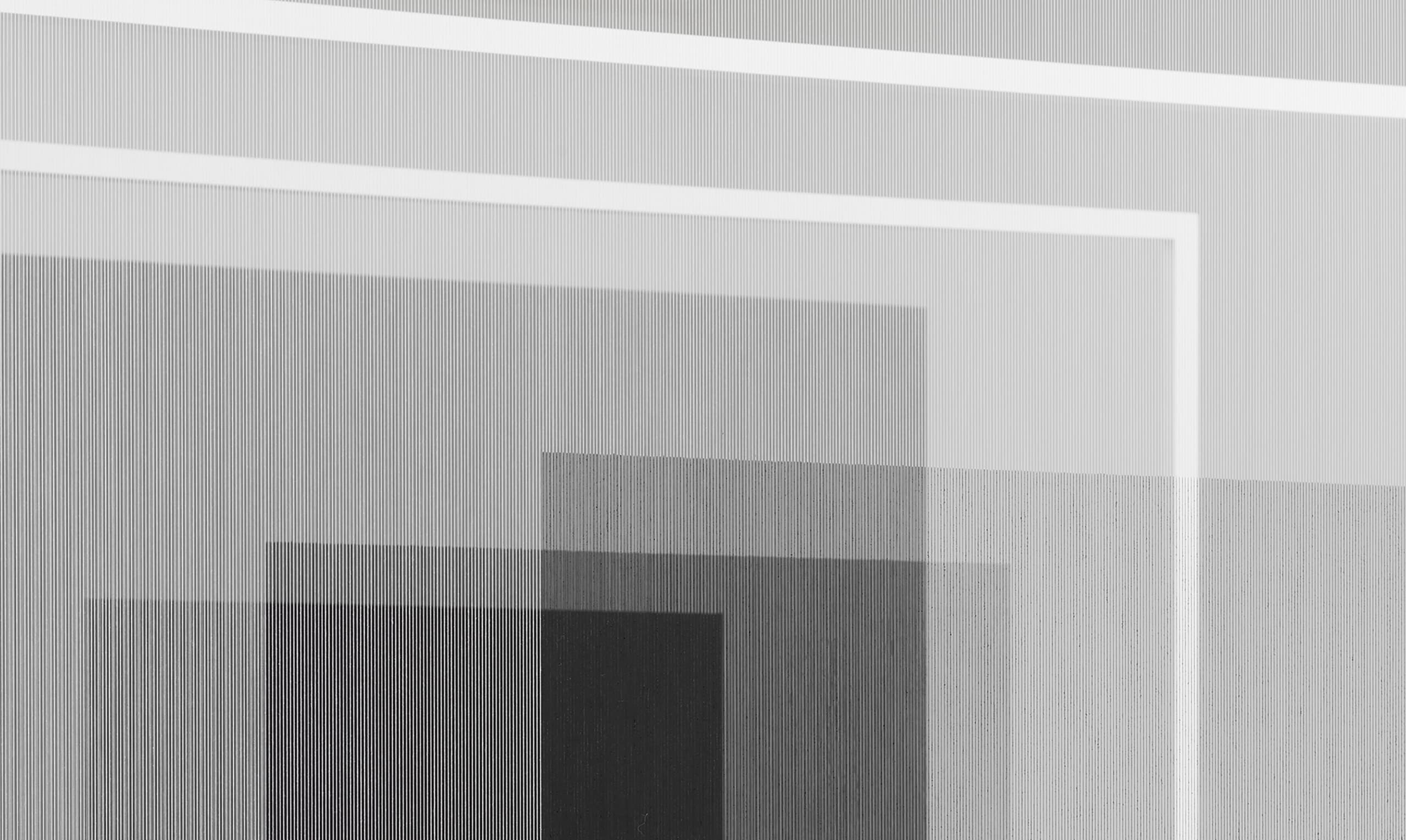
Hadi Tabatabai. TRANSITIONAL SPACES (Installation 2017) | Thread, acrylic paint, aluminum frame, wooden platfrom, 84 x 48 x 120 in (213 x 122 x 305 cm)
The planes of thread in Transitional Spaces recall the warp of a loom before weaving begins. The work is a freestanding installation consisting of a low plinth which holds a central panel, measuring 213 x 122 cm (84×48 in), that has been painted black on its front and back. It faces three additional panels of the same dimensions on either side of it, each separated by a distance of 45 cm. These panels consist of a layer of individual strands of white thread, stretched vertically over an open frame at 1.6 mm intervals. A rectangular section of the thread on each panel has been painted black, creating a visual “portal” when viewed from either side, as if the distance between the membranes of thread and the central black panel disappears.
Transitional Spaces functions as a painting that has come off the wall and become an immersive experience. Each of the piece’s six thread panels includes nearly 800 strands stretched vertically, adding up to a total of 11 km of thread. The rectangle of black painted on each panel leads the viewer’s eyes towards and seemingly through the piece’s dark center.
Although virtually every process that the artist has devised to make his work is almost inconceivably labour intensive, his practice is not an exaltation of such labour. Instead, it suggests a willingness to do whatever it takes to make objects that are as perfectly evocative of liminality as possible. In recent drawings, luminescent floating fields of blue are created by delicately applying seven or eight layers of coloured pencil with a layer of acrylic varnish between each successive application. In another group of pieces, the artist cuts a series of shallow grooves with a laser. Having filled them in with paint, he then sands the surface. Ten successive layers of paint, each meticulously sanded, are required to fill the whole cavity.
The laser cutter is the most recent addition to Tabatabai’s otherwise traditional arsenal of tools and methods. To Tabatabai, however, the ultramodern laser is merely a means to an end, no different from a straight edge. He describes his current use of it as accidental, in that what he wanted to do was to laser-cut a bevel, which turned out to be impossible. Experimenting, he discovered that an “incomplete” cut—a groove—offered new possibilities. In another series, the shadows cast by these tiny incisions into the matrix of Plexiglas constitute the lines that the viewer sees—a grid formed by absence, rather than presence.
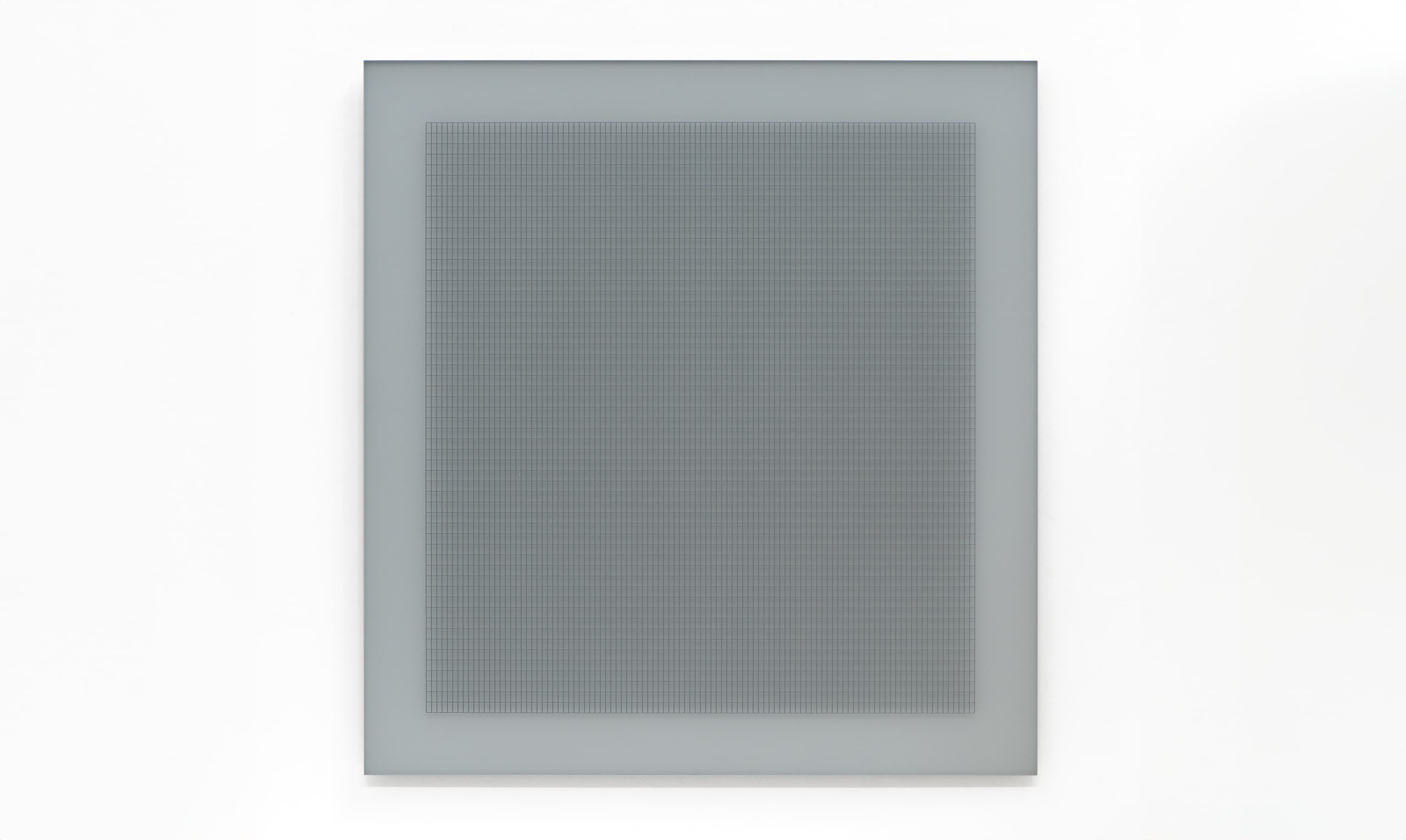
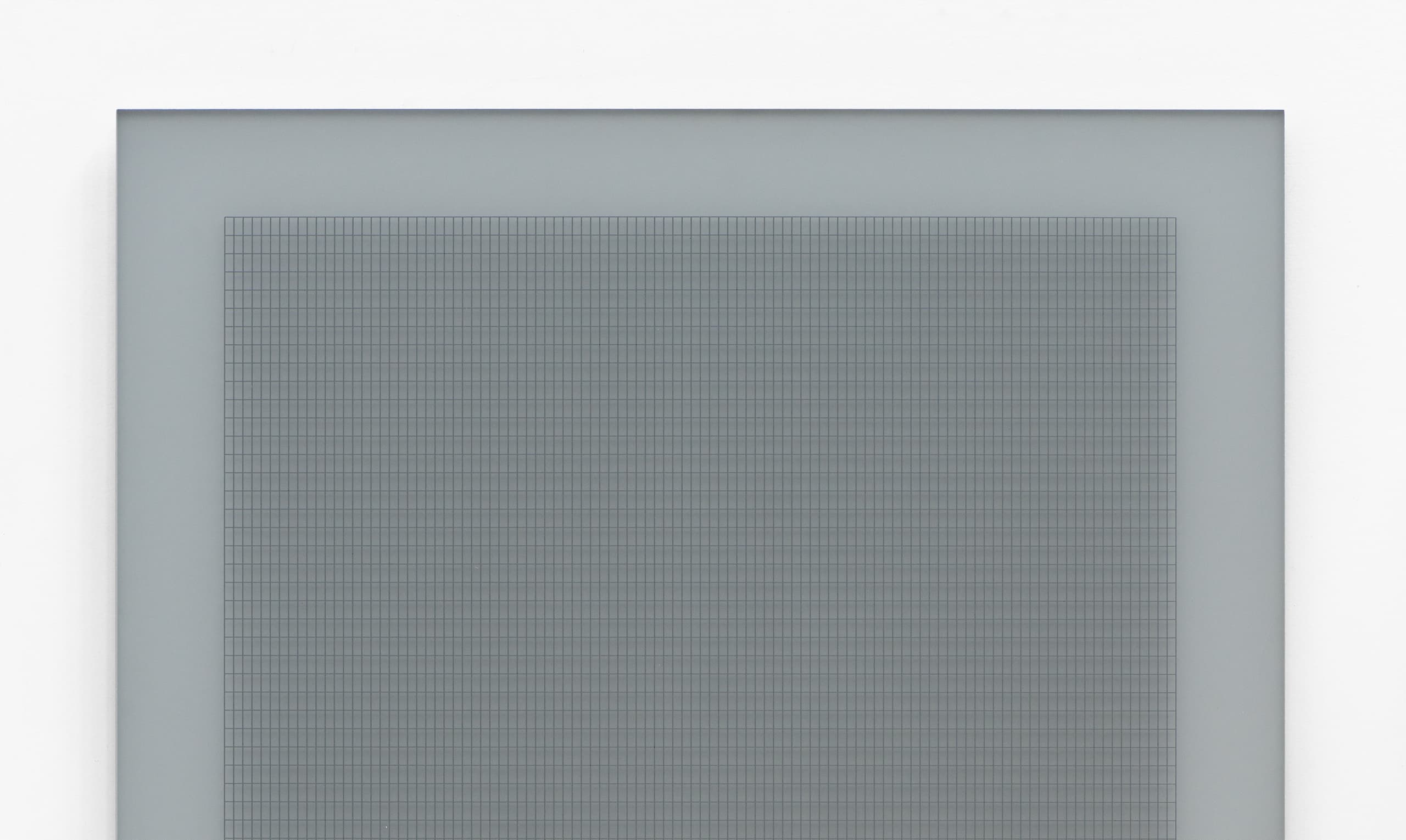
Hadi Tabatabai. ACRYLIC PIECE 2014-5 (2014) | Acrylic paint on acrylic panel, 17 x 16 x 0.5 in (43.2 x 40.6 x 1.3 cm)
Much of the artist’s practice is devoted to this kind of legerdemain—gestures and practices that suggest simplicity and effortlessness, when the opposite is true. Tabatabai asserts that this is a by-product of his motivation to make the work. He sees it as part of a lifelong learning process, describing it as an attempt to understand consciousness and create an ineffable, indescribable experience.
II. Sodachi
In the Japanese language, the word sodachi is used to describe the place where someone was born and raised, as well as the process and experience of childhood itself. Behind that identification lies the implicit belief that every location has a distinct and unique effect. Being from somewhere—even if one has left that place, and can never return—shapes one irrevocably, like the shake of the genetic dice that randomly hands down certain physical traits.
Born in Mashhad, Iran, Tabatabai spent only the first 13 years of his life there before emigrating to the United States. His experiences and memories of Iran are, as he puts it, essentially frozen in time; for him it will always be the place he left in 1977, before the revolution transformed the country. Settling in the Bay Area of San Francisco, he became a first-generation immigrant, attending local schools and obtaining degrees, first in construction engineering, then in painting. Although he has lived in California for more than forty years, he will always be an Iranian-American.
Taken as a whole, Tabatabai’s work suggests that “what’s past is prologue”2, meaning, everything in his life has created the conditions in which he functions as an artist, as well as the reasons for him making art. In conversation, he recounted a story that he read as a child. ‘An old man is planting a walnut tree in his yard. When a passerby asks why he plants a tree when he will never see the fruit from it, the old man says, “Others planted so that I would have fruit, so I am planting so that others will eat.”‘ The purpose of our lives, the story suggests—and, for Tabatabai, of art—is to be of both mundane and spiritual service, both now and in the future when only the art remains.
Stripped down to a minimal number of variables, almost ascetic in its purity and truth to materials, Tabatabai’s project can be seen as the culmination of a progression of similarly visionary modernist forebears. These include both Ad Reinhardt’s austere black paintings and Agnes Martin’s grids of pencil lines. However, there are also other, non-Western influences framing Tabatabai’s elegant explorations. Many of the methods and materials incorporated into his practice resonate both with Iran’s rich textile traditions and the widespread presence of non-representational pattern in tile-work and mosaics. Seen in this context, Tabatabai’s use of thread as line and grid is at once innovative, original and part of an age-old lineage. Whether Transitional Spaces is a journey into the unknown or the familiar, the past or the future, Tabatabai means it to lead us to a meditative space wherein resides the sublime.
— Maria Porges
- Maria Porges, “Blue Rice”, Shortest Stories, 2017.
- William Shakespeare, The Tempest, Act 2, Scene 1.
Maria Porges is an artist and writer whose work has been exhibited widely in solo and group exhibitions since the late eighties. She received a SECA award from the San Francisco Museum of Modern Art and has twice been in residence at the Headlands Center for the Arts. A finalist for the Creative Capital/Warhol Foundation Art Writer’s Grant in 2014 and 2016, her critical writing has appeared in many publications, including Artforum, Art in America, Sculpture, American Ceramics, Glass, the New York Times Book Review, and a host of other now-defunct art magazines. She has also authored essays for over 120 exhibition catalogues and dozens of scripts for museum audio tours.
Porges is a Professor at California College of the Arts in San Francisco, California.